Ontology-as-a-Service (OaaS): Building a Deterministic Digital Twin for Life Sciences AI

Steven Banerjee

Introduction
The pharmaceutical and biotechnology sectors are burning billions of dollars hoping that frontier large language models, left to their own devices, will spontaneously synthesize the next breakthrough therapeutic. They will not. The prevailing industry paradigm: throwing massive, unstructured datasets into a generic vector database, wrapping it in a basic retrieval-augmented generation (RAG) loop, and pointing a raw frontier model at it – is a recipe for multi-million-dollar operational failures and catastrophic hallucinations.
In high-stakes biology, the missing link isn’t just more compute or a larger context window. It is a rigid, formalized symbolic structure of meaning. To build a true “digital twin” of an enterprise’s scientific and business reality, we believe, organizations must abandon pure probabilistic guesswork and adopt a unified, machine-readable semantic core. This is the exact architectural mandate fulfilled by Nextnet’s Ontology-as-a-Service (OaaS) platform.
The argument goes that since biological data can be written in letters – whether as text in millions of PubMed articles or as character strings (A, C, T, G) in genomic sequences, a sufficiently advanced probabilistic language model can simply read its way to a therapeutic breakthrough. This premise conflates linguistics with physical reality. Biology is not a text corpus; it is a complex, non-linear, physical system governed by thermodynamics, structural chemistry, and evolutionary pressures. Textual descriptions of biology: research papers, lab notebooks, clinical logs – are merely flat, highly imperfect, and often conflicting summaries of multi-dimensional physical realities. Treating biological discovery as a reading comprehension exercise is a lethal operational error.
The Danger of Pure Probabilistic AI in High-Stakes Biology
The current generation of frontier AI models, including GPT-5.5, represents an extraordinary leap in pattern recognition and curve-fitting. Yet, they remain fundamentally detached from logical constraints. Even the engineers who build these massive models cannot map the exact interior of their latent spaces – the high-dimensional voids where concepts are compressed, tangled, and distributed across billions of parameters.
When applied to general tasks, a model’s ability to generate plausible-sounding prose is sufficient. In life sciences, however, “plausible” is a dangerous liability. Frontier models still exhibit a persistent hallucination rate on complex factual datasets (for instance, GPT-5.5 exhibits a hallucination rate of 86% on the Artificial Analysis AA-Omniscience benchmark). In a domain where a single misplaced decimal point or a misunderstood subject-object relationship can ruin a $100 million clinical trial or cause an oversight like Pfizer’s historic GLP-1 miss, relying on pure probability is organizational malpractice.
Probabilistic Large Language Models (LLMs) lack inherent logical boundaries. Without pairing classic formal symbolic systems (such as ontologies and knowledge graphs) with deep learning architectures, AI-driven drug discovery and clinical development cannot achieve the zero-hallucination thresholds required for enterprise deployment.
In standard human text, a word generally maps to a single clear concept. In biology, nomenclature is highly fragmented and chaotic. A single biological entity can have dozens of completely different names across isolated legacy databases and scientific papers. For example, the gene TP53 is frequently referred to as p53, BCC7, LFS1, or TRP53. A proprietary small-molecule compound will have an internal lab alphanumeric ID, a chemical SMILES string, an IUPAC name, and eventually a commercial drug name. Traditional RAG is blind to these links. If a scientist asks about p53, a raw text vector database will frequently miss critical insights hidden in an old internal file that only references the internal code BCC7. It cannot inherently reconcile that these disparate text strings point to the exact same physical node in reality.
An ontology acts as the definitive externalization of pattern and logic. By forcing frontier models to interact through an explicit description-logic framework – via ontology-enhanced GraphRAG and tightly constrained fine-tuning, we shift the AI from a state of ungrounded creativity to one of absolute semantic precision. The model is forced to see the biological world through a strict, expert-defined framework.
Anatomy of the Nextnet Digital Twin: The Architecture of Unified Knowledge
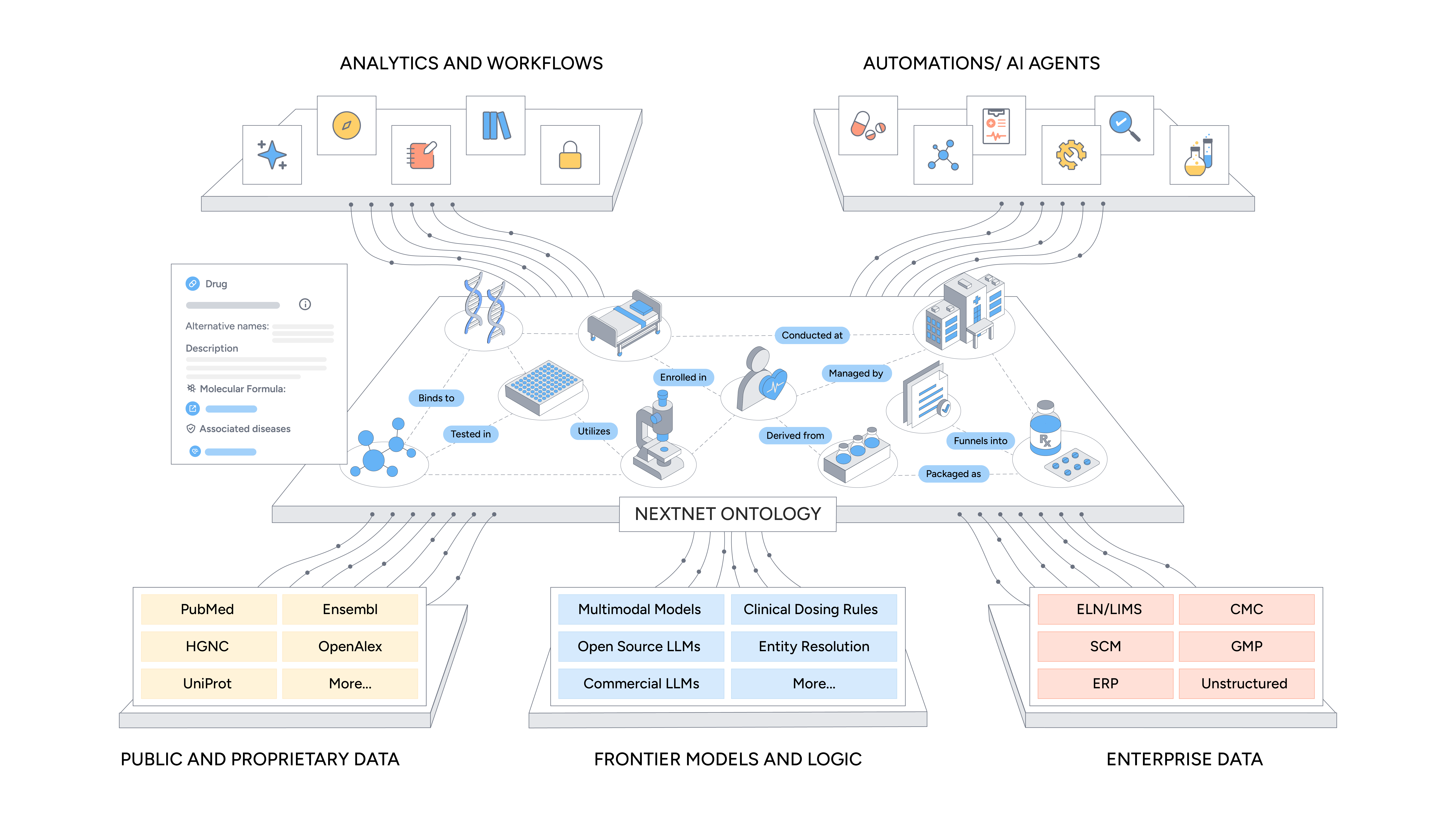
The operational power of this framework is best understood by dissecting the blueprint of the Nextnet Ontology system (using life sciences as an example), which seamlessly unifies data ingestion, LLMs, symbolic reasoning, and autonomous execution.
1. The Ingestion Foundation
At its base, the system unifies:
- Public and Proprietary Data: Millions of data points from biomedical and literature sources, including PubMed, HGNC, UniProt, Ensembl, OpenAlex and many more.
- Frontier Models and Logic: Commercial and open-source multimodal large language models.
- Enterprise Data: The private, highly sensitive operational core of the life sciences organization, spanning Electronic Lab Notebooks and Laboratory Information Management Systems (ELN/LIMS), Chemistry, Manufacturing, and Controls (CMC) documentation, Supply Chain Management (SCM), Good Manufacturing Practice (GMP) records, Enterprise Resource Planning (ERP) systems, and vast silos of unstructured text among others.
2. The Semantic Digital Twin Core
Rather than dumping these inputs into a static warehouse, Nextnet semantically tags and unifies them into a shared, living ontology. This digital twin maps the real-world dependencies of your scientific and commercial operations. For example, a Drug Object within the ontology is not just a row in a database; it is a dynamic entity possessing real-time properties:
- Alternative names
- Description
- Molecular Formula
- Associated diseases
This object is explicitly linked across the graph to its relevant Target, the targeted Disease, active Clinical Trials, participating Patients, and the precise Clinical Sites managing the studies.
3. The Application and Automation Layer
Sitting on top of this grounded semantic layer are the twin engines of enterprise productivity:
- Analytics & Workflows: An integrated knowledge workflow suite consisting of Copilot (for natural language queries), Explorer (for interactive, large-scale relational graph visualization and system dependencies), Notebooks (serving as a collaborative system of record to capture institutional memory), and a secure Data Library (search, analyze, ask and answer about anything in the Ontology) governed by rigid access controls. R&D biologists to clinical directors can transition from ideation to data discovery to formal documentation within a single environment, completely eliminating the cognitive friction of context switching.
- Automations & AI Agents: Unlike generic chat agents, Nextnet’s specialized AI agents inherit the logical constraints of the ontology. They execute complex, multi-step operational workflows with absolute fidelity to domain-specific rules.
The Economics of Meaning: OaaS vs. The Internal Build Trap
Life science organizations frequently fall victim to the “build-it-yourself” illusion, believing that the rational path involves hiring an internal army of data scientists and computational biologists to engineer a bespoke AI platform from scratch. Historical precedents reveal this to be an expensive miscalculation.
The failure of internal builds stems from the creation of incremental silos. Each single-purpose software application: whether a point solution for literature review, a basic chatbot, or an isolated data pipeline, creates its own fragmented context. Scientists waste significant percentages of their billable hours jumping between web browsers, disconnected internal databases, and legacy SharePoint files. By the time a cross-functional scientific question is answered, the underlying data is frequently stale.
Nextnet’s Ontology-as-a-Service (OaaS) delivery model bypasses this implementation risk entirely. By providing a complete, integrated software stack, Nextnet delivers a turnkey data and ontology operating system.
When an organization uploads an unstructured document, such as a complex Material Safety Data Sheet (MSDS) or a clinical study report, a Nextnet agent parses the text, extracts domain-specific entities tied to the enterprise ontology, and immediately correlates them with existing procurement, ERP, and scientific systems. Instead of querying databases via complex languages or writing custom code, wet-lab biologists interact with a contextualized digital twin via natural language.
The business value is both immediate and compounding. In the short term, organizations eliminate product management risk, execution risk, and the immense cost of lost institutional memory when key personnel depart. Over time, as more enterprise data, user annotations, and specific use cases are fed back into the system, the proprietary ontology becomes increasingly intelligent, highly differentiated, and secure. It transforms from an IT expense into the ultimate competitive moat for the age of AI.
The Non-Negotiable Path Forward
In the era of frontier AI, an organization’s ultimate competitive moat is no longer its access to generic computational power or public text corpora. True strategic differentiation tracks directly to the proprietary symbolic formalization embedded within its data layer. Companies that continue to rely on fragile, probabilistic text-shuffling wrappers will inevitably succumb to data debt, ruined wet-lab cycles, and catastrophic development failures.
Nextnet’s Ontology-as-a-Service (OaaS) AI infrastructure replaces probabilistic guessing with absolute relational logic. By unifying messy, private enterprise realities with the global network of scientific, operational and commercial knowledge, Nextnet delivers an evolving digital twin that continuously compounds in value. For life sciences enterprises serious about surviving the transition from digital bits to physical atoms, the Nextnet Ontology is not an optional software utility – it is the default data operating system.
Steven Banerjee
Latest
See the latest updates, research, events, and stories from Nextnet

Nextnet’s Ontology: Semantically Unifying Disparate Data
Spend some time exploring Nextnet and our software platform and you will encounter a distinctive word: ontology. We use it frequently, and it is easy to forget that it originated in Greek philosophy. In practical terms, ontology refers to a formal system that organizes concepts and the relationships among them. Nextnet’s ontology is a set of core technologies we have built to solve the complex data challenges that life sciences and healthcare enterprises face every day.