Nextnet Ontology Is the Moat. Models Are a Commodity.

Steven Banerjee
Nextnet Ontology Is the Moat. Models Are a Commodity.
Silicon Valley is currently trapped in a multi-billion-dollar hallucination. Approximately 95% of venture capital is currently flowing into commoditized generative AI “wrappers” that do little more than shuffle human text, draft marketing copy, or automate customer service scripts. These applications exist in low-stakes, low-density environments characterized by a high tolerance for structural failure. If a consumer-grade Large Language Model (LLM) hallucinates an adjective or drops a sentence in a marketing email, the net cost to the enterprise is near-zero or inconsequential.
But when you transition from the digital vacuum of software (“Bits”) to the physical reality of deep-tech, heavy industry and biopharma (“Atoms”), probabilistic guessing becomes a fatal liability. In life sciences, an AI error could be catastrophic: it could translate directly to ruined laboratory cycles, wasted physical inventory, failed pre-clinical animal validation runs, or lethal adverse events in a Phase I trial. Biology is governed strictly by the laws of biochemistry and biophysics, not the loose rules of grammar.
The industry does not need another reading comprehension tool or a flat vector search engine. It requires a deterministic, computable operating system that models the physical world exactly as it behaves. The Nextnet Ontology is that architecture. By shifting from a “Model-First” perspective to an “Ontology-First” paradigm, Nextnet establishes a fundamental reality: the LLM is a temporary commodity, while the structural ontology is the permanent enterprise moat.
Why Standard AI and Traditional Vector RAG Fails in Life Sciences
To understand why a raw text approach fails in life sciences, one must look at the structural mechanics of Retrieval-Augmented Generation (RAG). Standard RAG applications treat biomedical data as a flat reading comprehension problem. They take unstructured documents, such as Electronic Lab Notebooks (ELNs), Laboratory Information Management Systems (LIMS) exports, or assay PDFs, and slice them into arbitrary 500-word text chunks. These chunks are converted into mathematical vectors, dumped into a vector database, and retrieved via basic keyword proximity searches.
In other words, when a business or technical user queries the system, it runs a probabilistic keyword proximity match (such as cosine similarity) to extract text chunks that look statistically similar to the prompt, shoves that raw text into the LLM window, and hopes the model can synthesize a factually coherent answer.
This methodology is blind to multi-step, cross-silo structural relationships. Consider a real-world operational failure mode within a biotech firm’s repository:
- The Source Data: Page 2 of an internal ELN document notes: “We synthesized Compound N-402 and tested it against target kinase BTK.”. Separately, on Page 45 of an unlinked appendix table, assay telemetry logs indicate that Compound N-402 induces a 92% cell mortality rate in healthy human hepatocytes at low concentrations.
- The Query: A principal investigator asks the AI platform: “Show us all internal small molecules that effectively inhibit BTK without exhibiting acute hepatotoxicity.”
- The Breakdown: The vector database executes a similarity match on the tokens “BTK inhibition” and “hepatotoxicity”. Because the structural link between the synthesis note on page 2 and the raw data rows on page 45 relies on an implicit, multi-step experimental relationship – not adjacent words in a text block, the vector search fails to bridge the gap. The system misses the toxicity flag entirely, hallucinates a clean safety profile by omission, and returns Compound N-402 as a viable lead. A mistake of this magnitude burns millions of dollars in physical reagents, destroys months of execution velocity, and endangers human lives in downstream clinical trials. Hence unknowingly sentencing the program to a multi-million-dollar clinical dead end. It is exactly this flavor of human oversight and trapped institutional memory that led to Pfizer’s multi-billion-dollar GLP-1 asset write-down.
Vector search cannot reason over what it cannot see adjacent to its chunk limits. It manipulates tokens based on co-occurrence probabilities in its training data without any baseline understanding of the binding affinity of a ligand, the steric hindrance of a pocket, or the phenotypic variations of a cell line.
The Nextnet Architecture: Unifying the Fragmented Stack
Nextnet bypasses the text-chunking trap entirely by inserting a deterministic, structured semantic ontology directly between the language model and raw corporate data repositories. It acts as a secure “playground” where AI agents do not read raw, unstructured text strings. Instead they read neatly defined Objects and their rigid, multi-dimensional relationships.
The diagram below illustrates how Nextnet’s operational brain layers across an organization’s existing data architecture without demanding a costly forklift replacement of infrastructure.

Decoding the Visual Interface
As shown in the framework, the underlying storage layers: whether they live in a Data Warehouse, a Data Lakehouse, a Data Lake, or siloed Systems of Record, are treated purely as passive storage infrastructure. Nextnet does not replace your investments in Snowflake, Databricks, or cloud systems like Benchling and Veeva; it sits on top of them.
The translation layer converts fragmented, unstructured telemetry into a unified semantic graph. Let’s trace the exact nodes mapped in the life sciences ontology view:
- The Biochemical Axis: A distinct genomic or structural entity
(DNA)is mapped directly through typed predicates("Binds to")to a specific chemical profile(Molecule). - The Experimental Axis: This
Moleculeis linked via transactional metadata("Tested in")to a physical high-throughput screening asset(Well Plate), which directly("Utilizes")specific instrumentation data(Microscope). - The Clinical Axis: The real-world operational tracking correlates a clinical participant
(Person)who is("Enrolled in")the trial, showing that their sessions were("Conducted at")a distinct medical center(Hospital), while their primary administrative profiles are("Managed by")strict documentation protocols. - The Supply Chain Axis: Biological material
(Vials)("Derived from")the patient are structurally traced as they are("Packaged as")formal therapeutics(Meds), which ultimately("Funnels into")the hospital network for deployment.
When a user queries this system, Nextnet does not run a probabilistic keyword match. It runs a precise graph traversal query across these mathematically locked pathways. In the case of Compound N-402, the Nextnet ingestion engine immediately parses raw lab data, resolves entities, and links them directly into the explicit ontology. Compound N-402 is mathematically locked to its synthesis log, bound to the BTK kinase target, and structurally tied to the Hep-04 assay yielding an absolute cell viability score of 8%. When the scientist executes the query, Nextnet does not guess text similarity; it executes a rigorous graph traversal across these immutable predicate paths. It instantly filters out Compound N-402 because the path between the molecule and the hepatocyte death line is mathematically traceable and deterministic. Hence the system traces the connection from molecule to well plate to assay telemetry instantly, flagging the hepatocyte viability drop and filtering out the toxic compound with absolute certainty. Nextnet queries the structural architecture of the science itself, not the messy text descriptions written about it.

Ontological Commitment vs. Statistical Curve-Fitting
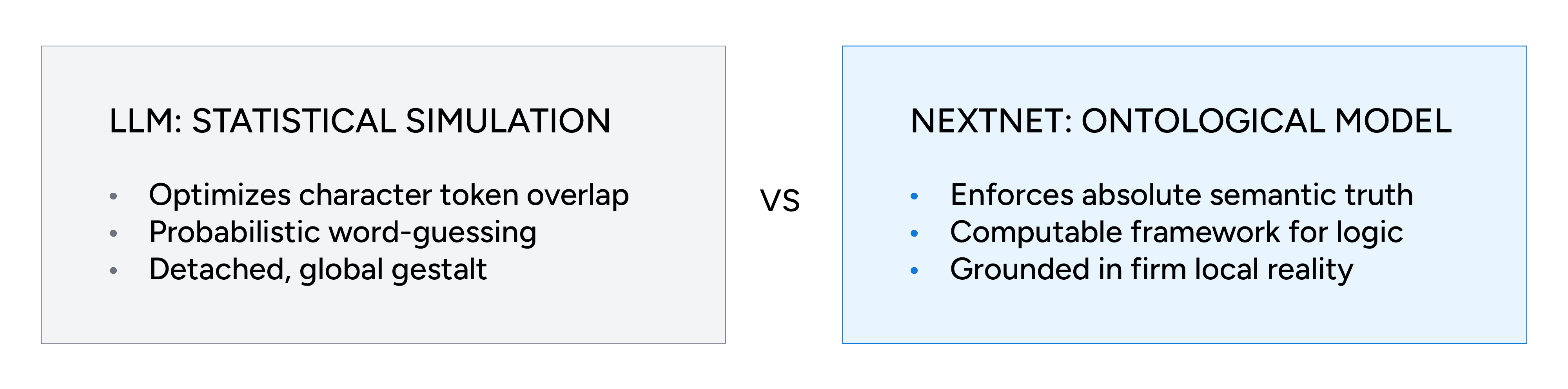
The fundamental difference between raw generative AI models and the Nextnet platform comes down to a core philosophical and mathematical distinction: LLMs are curve-fitting simulations, whereas Knowledge Graphs are ontologically committed models.
Large Language Models are fundamentally statistical systems designed to predict text patterns based on correlations observed across internet-scale datasets. They minimize prediction error by optimizing billions of floating-point parameters, operating as highly advanced curve-fitting mechanisms. They capture a form of latent, global semantics, but this intelligence is completely ungrounded in the specific, high-consequence reality of an individual organization. They excel at fluency, but they completely lack formal, structured understanding.
Nextnet’s Knowledge Graph operates via ontological commitment. It demands a deliberate, explicit stance on exactly how data entities are defined and how they are permitted to interact. Within the Nextnet Ontology, a "Patient," a "Biomarker," or a "Clinical Trial" is not a flexible, floating-point token floating in a probability vector. It is a formally bounded entity with explicit, logical constraints and traceable provenance.
By running these two architectures in a continuous Neural-Symbolic Loop, Nextnet creates true Semantic Agents. The generative flexibility and conversational fluency of the frontier model layer are tightly bound inside the structural reasoning grid of the ontology. The ontology defines the boundaries, enforces the security protocols, and dictates the logic; the AI model navigates within that safe, structured playground to explore data safely and eliminate hallucinations entirely.
Conclusion: Strategic Defensibility in the Era of Commoditized AI
In an era where raw computational intelligence has become a cheap, widely accessible commodity, renting generic foundation models provides zero long-term competitive advantage. Anyone with an API key can build a basic text interface. The true source of modern strategic differentiation is not a marginally better curve-fitting algorithm; it is owning a superior, highly differentiated model of the world.
Organizations that fail to establish an independent ontology will inevitably rent generalized, undifferentiated intelligence from massive public model labs, leaking their proprietary institutional meaning out into the ether. By making clear, thoughtful ontological commitments through the Nextnet platform, life sciences organizations firmly secure their proprietary data, capture their tribal knowledge, and insulate their operations from catastrophic AI hallucinations. They don’t just use AI to passively read their past data, they partner with AI to actively orchestrate their future discoveries.
Steven Banerjee
Latest
See the latest updates, research, events, and stories from Nextnet


Nextnet’s Ontology: Semantically Unifying Disparate Data
Spend some time exploring Nextnet and our software platform and you will encounter a distinctive word: ontology. We use it frequently, and it is easy to forget that it originated in Greek philosophy. In practical terms, ontology refers to a formal system that organizes concepts and the relationships among them. Nextnet’s ontology is a set of core technologies we have built to solve the complex data challenges that life sciences and healthcare enterprises face every day.