Explorer: Brainstorming maps of connected science
The connected search engine for life sciences. Visualize data and connect complex ideas in a collaborative, interactive way.

Assisting researchers around the world:
Why researchers need Nextnet
The Connected Search Engine for life sciences. Visualize data and connect complex ideas in collaborative, interactive, brainstorming maps. Powered by a semantic web unifying the world’s biomedical data.
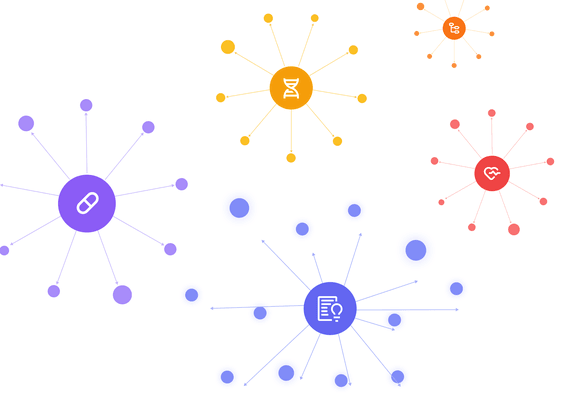
Visualize connected
With Connected Search results, effortlessly connect complex ideas in collaborative brainstorming maps or as browsable lists ranked by relevance.
Key features of
Discover the powerful features that make Explorer the most productive tool for your research.
Explore connected data entities
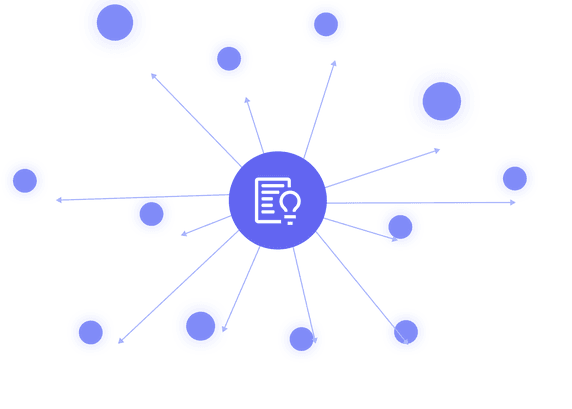
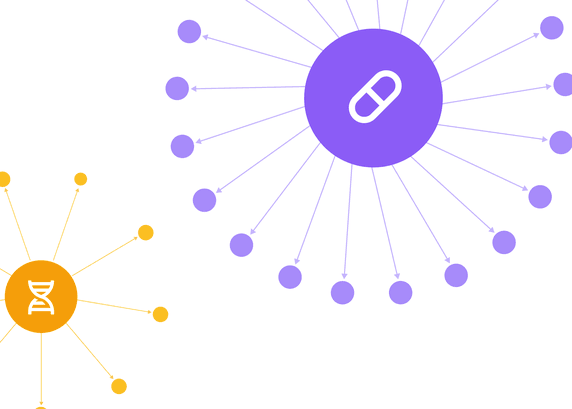
Explore data nodes & relationships with advanced viewing tools to gain deeper insights and make informed decisions.
- Discover relationships across literature, genes, drugs, targets, pathways, diseases, institutions, authors, and more.
- Pinpoint the most relevant results by search ranking.
- New data nodes coming soon include patents, clinical trials, and research grants.
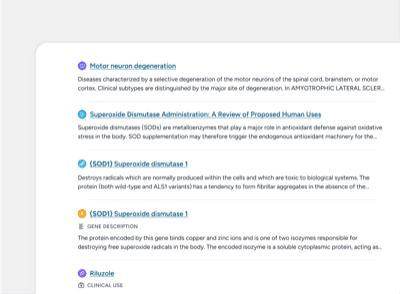
Detailed data entity cards
Review data entity cards of any node or relationshp, quickly scanning through relevant properties and navigating to other connections.
- Detailed properties are aligned to each card. Filter to search similar entities with common properties.
- Discover similar and recommended entities beyond the card’s direct connections.
- Access metadata associated with data source creation and update.
Augment with GenAI to expand insights
Take the search results to another level by augmenting them with GenAI.
- Curate interesting findings and expand your knowledge through the AI Overview feature.
- AI Overview features gives you additional insights, opening up new navigation routes.
- Take your research well beyond what you ever anticipated to ask.
“Links between genes, proteins, and pathways found within seconds that would have otherwise taken me weeks. The knowledge graph in Explorer has the potential to help me discover previously hidden pathways and design better T cell therapies.”
Dr. Cassian Yee, MD Anderson Cancer Center
FAQS
Questions &
If you have any other questions – please get in touch.
What is Nextnet Explorer?
What is a Connected Search Engine?
Is a Knowledge Graph the same as a Knowledge Map?
What is the difference between Map and List views in Explorer search results?
How do I access the underlying data behind the nodes in Explorer?
What new features are coming, and when can I start using them?
- AI Overview – Get a high-level summary and ranking of key concepts surfaced by Explorer, helping you quickly understand relevance before diving deeper.
- Real-time collaborative comments – Team members with access to your workspace will be able to comment directly on the Map View, enabling real-time multi-player collaboration.
- Research Article Reader – Read and annotate scientific papers within a beautifully designed in-app reader.
- Expanded Node Exploration – Perform broad semantic web searches by expanding nodes to second, third, or higher-degree connections.
- Advanced Filtering Options – Including Temporal Analysis, which allows you to explore patterns over time and trace event sequences interactively.
- Common Property Finder – Discover shared properties between nodes to spot patterns, trends, and insights across massive datasets. This will be a game-changer for finding hidden connections, analyzing and exploring trends, and combining different filters and visualizations to generate some hypotheses worth sharing.
What is an ontology?
Get started
Try Nextnet
Join thousands of life scientists already using Nextnet to next level their research and accelerate R&D.