Nextnet’s Ontology: Semantically Unifying Disparate Data

Steven Banerjee

Introduction
Spend some time exploring Nextnet and our software platform and you will encounter a distinctive word: ontology. We use it frequently, and it is easy to forget that it originated in Greek philosophy. In practical terms, ontology refers to a formal system that organizes concepts and the relationships among them. Nextnet’s ontology is a set of core technologies we have built to solve the complex data challenges that life sciences and healthcare enterprises face every day.
We believe that scalable and sustainable data ecosystems need an ontology as a core component. In this short blog post, we explain what we mean by ontology, how we apply it using our cloud architecture, and why it matters.
What is an ontology?
Large language models feel like mysterious black boxes. You ask a question, an answer appears, and the steps in between remain opaque. Even the engineers who design these systems cannot fully explain what happens inside. That hidden interior is the latent space, a high-dimensional environment where models compress and transform concepts.
With enough parameters and training data, a model learns to predict what comes next with remarkable accuracy. The challenge is that the knowledge it learns does not live in neat folders. They are distributed across millions or billions of parameters. They are entangled in ways that humans cannot easily inspect.
This is where ontologies enter the picture.
The major advantage of Nextnet’s ontology is its formal structure of precisely defined concepts and relationships. With the right instructions and context, we guide LLMs to identify and build parts of the ontology, while also using its structure to generate insights across domains and concepts. We are providing models with an intelligent scaffolding for efficient and accurate insight generation.
A well-built ontology can also leverage a wealth of human talent. Your company’s experts can align it with your domain, how your organization understands the world and how you want to represent knowledge. This is not a perfect window into the model’s latent space, and it does not need to be one. What matters is that once the structure exists, you can reshape it. This refined conceptual organization can then be fed back into your systems through ontology-enhanced retrieval (e.g., GraphRAG), graph-based reasoning, or fine-tuning guided by ontological structure.
The result is a dynamic system that interprets information and reasons through a framework you define.
Why now?
Structured ontologies enhance generative AI through two key ways: accuracy and efficiency. While providing something generative AI urgently needs: grounding.
LLMs excel at creative generation but often lack consistent logical boundaries. Ontologies supply the formal structure that anchors meaning. They harmonize wildly different data sources into a coherent semantic layer. When precision matters more than plausible text, ontologies provide one of the most reliable ways to keep AI from hallucinating.
Why does an ontology matter?
Ontology traces back more than two thousand years to Aristotle, who attempted to formalize how humans perceive reality. Modern ontology continues that work. It defines the concepts and relationships that shape a domain in a rigorous, logical way.
During the early internet, Sir Tim Berners-Lee proposed the Semantic Web, a vision in which data, not only documents, connects in meaningful ways. He argued that if every concept had a unique identity, machines could understand meaning more directly. Google later advanced part of this vision with Schema.org, which created shared vocabularies that allowed search engines to better understand the public web.
The new frontier is not the public web. It is the enterprise.
Life sciences enterprises want AI agents that can reason about their internal data: experiments, ELNs (electronic lab notebooks), clinical trials, patents, customers, assets, and processes. They need semantic clarity applied to their own messy, private reality. Disambiguating meaning is no longer optional. It has become essential.
Organizations also cannot outsource their ontology. Every enterprise needs its own internal version of Schema.org, built on open standards and owned by the organization itself. Anything less increases the risk of IP leakage and vendor lock-in. In the age of AI, ontology is a core part of the competitive moat.
How Nextnet uses Google Cloud to power our ontology
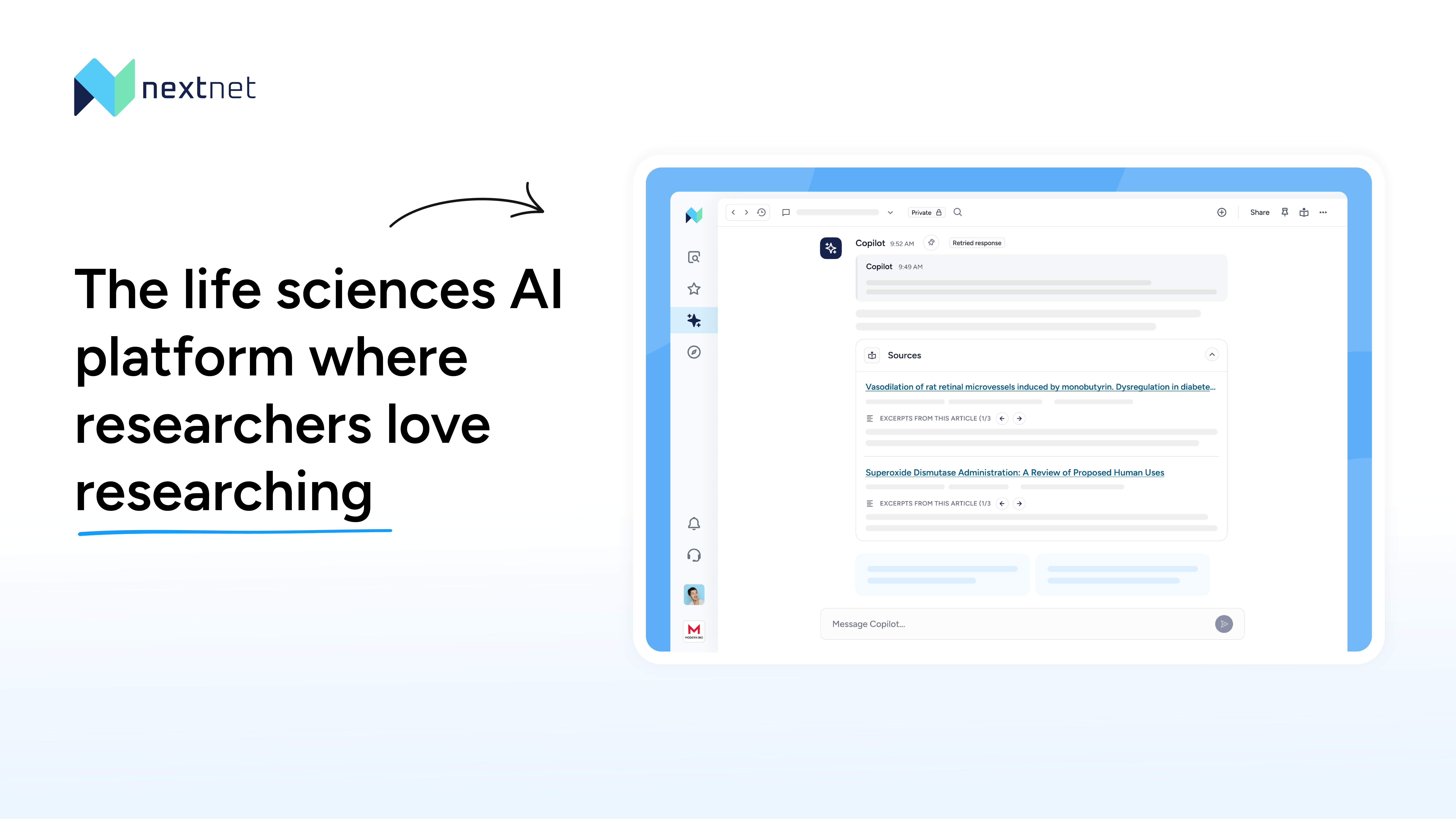
Nextnet provides the AI application layer for life sciences. Our platform allows teams to move from discovery and ideation to collaborative decision-making and knowledge management without constant context switching. Think of it as a trusted knowledge companion for health and life sciences, built on the world’s largest semantic web of health, life sciences and biomedical data. Our users span more than 100 countries.
Nextnet’s breakthrough has been to build our ontology specifically to connect biomedical data across disparate data sources and contexts. We have integrated most of the large public datasets that are used by researchers today. But we have gone further to include scientific literature, clinical trials, patents, and other commercial datasets. We also integrate proprietary data sources through partnerships. We semantically tag and standardize this information and connect it into a unified semantic network. Organizations can securely connect their internal data to this ontology and the broader knowledge graph. They can then ask mission-critical questions across their contextual knowledge base and uncover insights that would otherwise remain hidden.
Google Cloud and Gemini play a central role in this architecture. Semantic insights from Google Gemini power many of the relationships inside our ontology. We use Gemini to identify and build connections from primary scientific sources. Google Cloud text embeddings help categorize and deduplicate entities across databases, which is crucial for semantic unification. Grounding services that rely on Google Search support informed responses for users. We plan to use Gemini’s direct-to-document response generation to help users create reports, and we expect to explore Google Cloud image embeddings for figures and tables.
Conclusion
The motivation is straightforward. Ontology allows data ecosystems to grow and evolve while generating compounding value rather than compounding disorder. Ontology is not just a documentation exercise or a knowledge management tool. It represents a strategic capability in the data pipeline. When designed well, it compresses meaning, reduces chaos, and brings clarity to your AI efforts.
Steven Banerjee
Latest
See the latest updates, research, events, and stories from Nextnet